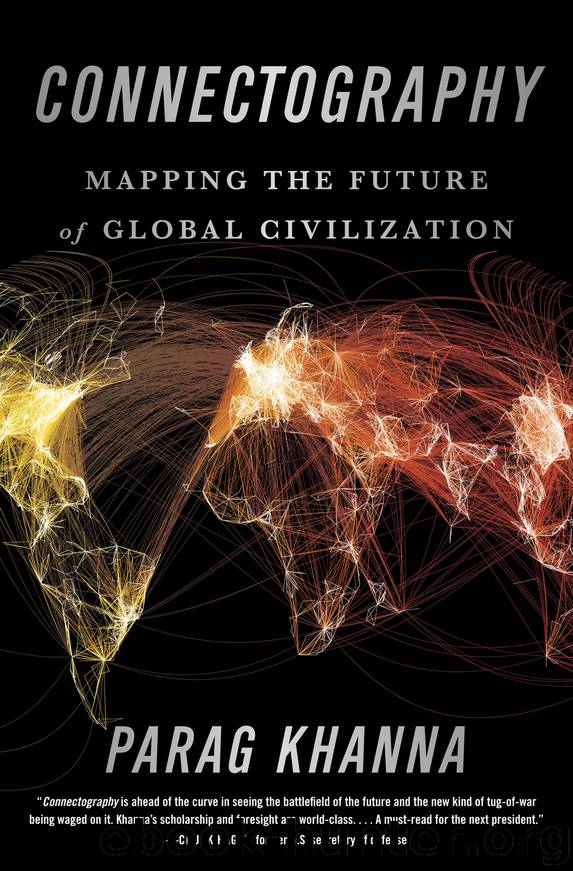
Connectography by Parag Khanna
Author:Parag Khanna
Language: eng
Format: epub
Publisher: Random House Publishing Group
Published: 2016-04-18T16:00:00+00:00
THE SUPPLY CHAIN STRIKES BACK
Supply chain empires of the past have been undone by a combination of indebtedness and inflation at home and unrest and competition abroad. Falling silver imports from South America hastened the decline of the Spanish Empire, while four Anglo-Dutch wars spread over a century gradually weakened Dutch control of South Africa and Ceylon. Divergent priorities in imperial capitals have also been a major factor. British investors poured money into Indian railways assuming the Raj would last forever, but the growing independence movement—and the British prime minister Clement Attlee’s acquiescence in it—effectively chased weary London investors out of India.
Supply chain wars are nothing new to China—except they have historically gone in the other direction. When the Qing dynasty emperor Daoguang seized and destroyed British opium stock in Guangzhou in 1839, Britain responded with overwhelming force, occupying Hong Kong and imposing extraterritorial rights across the country. For China, the Opium Wars marked the beginning of a century and a half of humiliation from which it feels it is only now recovering.
The principal geopolitical question for many countries today is not whether the United States and China will go to war in the Pacific but whether China will use its supply chain empire to inflict “unequal treaties” on them the way the British did to China two centuries ago. Since the 1990s, China’s checkbook diplomacy has underwritten nearly frictionless commercial expansion, buying up raw materials in pricey long-term contracts from Argentina to Angola in exchange for building schools, hospitals, government offices, and highways. It pledged noninterference in local politics, which actually meant selling unlimited arms to governments to preserve the status quo. China managed to—and still does—maintain good relations with important pairs of regional rivals: Brazil and Venezuela, Saudi Arabia and Iran, Kazakhstan and Uzbekistan, and India and Pakistan.
But in a growing number of countries, the honeymoon is over; the blowback has begun. All superpowers eventually suffer blowback; it’s just a matter of time. Ironically, the CIA itself coined the term to warn of the consequences of its role in the chain reaction that led to Iran’s anti-American hostility following its 1979 revolution. That same year, in yet another spark of long-term blowback, the CIA began its largest clandestine operation—funding the anti-Soviet mujahedeen that eventually devoured the Red Army—which also spawned the Taliban that sheltered the 9/11-mastermind, Osama bin Laden.
China already knows blowback: Its heavy-handed pacification of its largest province, Uighur-Muslim-populated Xinjiang, led to a suicide car-bomb attack right on Tiananmen Square in Beijing in 2013 and dozens of other terrorist incidents. But the blowback against China abroad is different. China’s global presence is defined not by its military but by its supply chains. Its key agents abroad are not intelligence agencies but state-owned companies. For China, supply chain blowback is geopolitical blowback. It is also a reminder that building infrastructure abroad doesn’t guarantee China will ultimately control it. The winners in supply chain geopolitics are still far from certain.
Blowback reminds us that we live in a world of complexity rather than linearity and of the compressed timescales of today’s feedback loops.
Download
This site does not store any files on its server. We only index and link to content provided by other sites. Please contact the content providers to delete copyright contents if any and email us, we'll remove relevant links or contents immediately.
| Anthropology | Archaeology |
| Philosophy | Politics & Government |
| Social Sciences | Sociology |
| Women's Studies |
Cecilia; Or, Memoirs of an Heiress — Volume 1 by Fanny Burney(32558)
The Great Music City by Andrea Baker(32018)
Cecilia; Or, Memoirs of an Heiress — Volume 2 by Fanny Burney(31956)
Cecilia; Or, Memoirs of an Heiress — Volume 3 by Fanny Burney(31941)
We're Going to Need More Wine by Gabrielle Union(19046)
All the Missing Girls by Megan Miranda(16023)
Pimp by Iceberg Slim(14506)
For the Love of Europe by Rick Steves(14121)
Bombshells: Glamour Girls of a Lifetime by Sullivan Steve(14073)
Talking to Strangers by Malcolm Gladwell(13370)
Norse Mythology by Gaiman Neil(13363)
Fifty Shades Freed by E L James(13239)
Mindhunter: Inside the FBI's Elite Serial Crime Unit by John E. Douglas & Mark Olshaker(9339)
Crazy Rich Asians by Kevin Kwan(9291)
The Lost Art of Listening by Michael P. Nichols(7506)
Enlightenment Now: The Case for Reason, Science, Humanism, and Progress by Steven Pinker(7311)
The Four Agreements by Don Miguel Ruiz(6765)
Bad Blood by John Carreyrou(6621)
Weapons of Math Destruction by Cathy O'Neil(6279)
